
How do you pack a Stroud drag chute?
This video explains the chute packing process quite well.
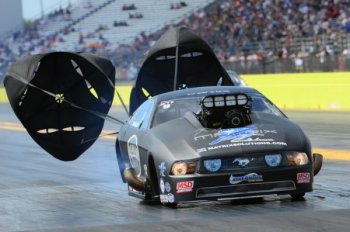
When is a parachute required by NHRA and IHRA?
All cars that go over 150 mph in the quarter mile are required to have AND USE a chute. Dual chutes are REQUIRED for any vehicle over 200 mph.
What is the most common mistake that racers make when using a parachute?
Not using a chute! Racers often leave it packed for years and when they finally get into trouble it will not work. This is because the chute becomes compressed and will wedge itself in the pack and will not want to deploy even with a spring pushing on it. It can also lead to deterioration of the chute itself from moisture.
The ONLY time the chute should be packed is at the racetrack, when the car is in the trailer or garage the chute should be unpacked.
IT WILL NOT WORK IF IT IS LEFT PACKED ALL THE TIME!Ideally, after your last pass at the races you should remove the chute and shroud lines from the car and place it in something like a milkcrate where it can breath. This is also a good time to inspect for any damage. Then when you get it home, store it in a dry location out of the sun. Do not put the chute back on the car till you take the car back out again, ideally you should repack the chute AT THE TRACK. If you make this procedure a habit, you will always have a fresh pack and a chute that will work when you need it. IF YOU FAIL TO DO THIS THE CHUTE MAY NOT WORK.
It is also a good idea to deploy the chute at least once each outing whether you need it to stop or not. This practice will help you learn what the chute will do for you and you will become used to how it works when you need it.
There are a few different designs out there for the parachute canopy, what's the benefit and/or disadvantages of the different designs?
There are 2 designs presently being used for drag racing, the Stroud design and the cross form design. The Stroud design was specifically designed for vehicle applications by an actual parachute designer. It is built only by Stroud Safety and is legally protected design.
The cross form style chutes are actually an old 1920's French military design that were originally used for cargo drops. They didn't work great in that application but they are a cheap design to manufacture.
In use the Stroud design opens much softer because of it's deployment bag system which takes the slack up out of the shroud lines before the canopy opens. This makes it much more reliable, stops the vehicle quicker with less chassis upset. A side benefit is the deployment bag system is it makes the chute packing much easier, it can be packed in just a few minutes by one person.
Cross form design chutes tend to open the canopy before the shroud lines are tight generating a hard hit on the car when the shroud lines finally tack up their slack. This is harder on the car due to the larger impact and they are much harder to pack, usually requiring two people.
How high off the ground should the anchor for the chute connect to the chassis?
Always contact a chassis builder with experience in that, but the general rule of thumb is somewhere through the crank or cam shaft centerline if it is a door car. Again, always contact an experienced chassis builder before you start cutting. The ideal anchor point is perfectly centered on the car (from right to left) and vertically at the center of mass from the rear of the car. This center of mass would be the point which if you picked the car up off the ground using a crane it would hang exactly vertical.
What is the most common mistakes that racers make when choosing a chute for their car?
They look at price and what they think they want, not what they actually need. They want it to be mounted out of the way so they will not have to notice it. Unfortunately, when they need it to work it will not. So much for cheap.
What is the proper mounting location and angle for the parachute pack? Is this critical?
The proper angle for the chute pack is 45 degrees from the horizontal, and up and BEHIND the spoiler, not under it. This is VERY critical for proper opening of the chute.
On a dual mount chute setup, should the chutes angle away from each other a few degrees, or should they be parallel?
I always recommend that the chutes be angled away from each other 15 degrees. The reason for this is simple. They are easier to pack, that is the only reason.
When should you use a net over your wheelie bars to prevent the chute from getting tangled up? Some cars have these but others don't, should everyone use them?
If you have a drag chute and wheelie bars you need a net. Always. Period. If not, the chute will go under the car and beat you to the finish line. Not very pretty.
Approximately how hard does a single parachute pull on a car, say at 150 mph?
You are looking at 1 to 1 1/2 g's for a Stroud chute, and quite a bit higher than that for a crossform design. Stroud's are designed to open softer and more reliably. A crossform design hits very hard because the canopy opens before the slack in the shroud lines are out. The Stroud opens much softer because it uses a patented deployment bag which regulates the opening sequence in a much more controlled manner.
Can you explain the benefits of the different release mechanisms that are available? Is one more reliable than another?
All release cable kits made by reputable manufacturers are OK. The push button release kits are OK with some caution. Avoid ANY push button kit the replaces the original push handle. The original push handle is your back up.
Is there a good rule of thumb to use for how early before the finish line you should deploy the chute? Do you "drive into" the parachute or deploy it after hitting the brakes?
The chute doesn't begin to exert drag on the vehicle until it is inflating. Pulling the chute at the last mph light is a good place to start, thus you are still under power. However, a chute doesn't know the difference between acceleration and deceleration. It only knows MPH and mass, and is most effective at higher speeds. This is somewhat like your 60' times for acceleration, you seldom can make up any ET that is lost in the first 60', the opposite applies to the shutdown, the first 60' of braking force makes the most difference in how quickly you can stop and the chute will be the most effective if it is deployed at your highest MPH.
Which flap should fold last, opposite the rip cord or the same side as the ripcord?
The flap opposite the ripcord is always the last to close. That way the ripcord is pulling against the loop, not with it.
Any tips on taking care of a parachute like for winter storage and for cleaning?
A chute is unique and unlike many things on a race car, it will often last a lot longer if you use it frequently. A chute that is opened each time you have the car out and stored open in a dry location will last longer 4x5 times longer than one that is not. Failure to open the chute frequently or just leaving the chute packed on the car will lead to deterioration due to rot and most likely a non-functioning chute when you need it. Wash your chute regularly with soap and Castrol Super Clean (1/2 and 1/2), then air dry it. You can wash it in the washer, use cold only and delicate cycle. Air Dry Only - don't put it in the dryer!
Also keep the chute out of the sun as much as possible.
Thanks to Bob for taking the time out of his day to answer these questions in detail!
If you have any questions or need a parachute give Stroud Safety a call at 1-800-554-4648 or on the web at www.stroudsafety.com/
More Info
- How to Pack and Care for a Stroud Parachute - PDF Format Instructions